





Skip to content

Lessons Habitat

Lesson Plans & Teaching Resources for Educators

  • About Us
  • Privacy Policy
  • Contact Us
  • Disclaimer
  • Terms and Conditions
  • FAQs
  • Toggle search form
  • Musical Instruments in Nigerian Celebrations: Types, and Uses
    Musical Instruments in Nigerian Celebrations: Types, and Uses Primary School Lesson Plans
  • blackboard, learn, language, language school, chalk, text, chalkboard, education, school, student, word, communication, english, elementary, course, learning, studying, classroom, gray school, gray education, gray learning, gray study, gray classroom, gray community, gray communication, gray studying, gray language, gray blackboard, language, language, language, language, language
    Parts of Speech English Grammar Primary 6 Primary School Lesson Plans
  • Best Ways to Manage Farm Animals (Feeding, Records, & Sanitation)
    Best Ways to Manage Farm Animals (Feeding, Records, & Sanitation) Primary School Lesson Plans
  • Whole Numbers Lesson Plan for Primary 1 | Lessonshabitat Primary 1 Scheme of Work
  • Common Diseases of Farm Animals
    Common Diseases of Farm Animals Primary School Lesson Plans
  • Things Found in the Soil | Primary 1 Basic Science
    Things Found in the Soil | Primary 1 Basic Science Primary 1 Scheme of Work
  • Pollination, Fertilization, Budding, and Coloration
    Pollination, Fertilization, Budding, and Coloration Primary School Lesson Plans
  • Home Furniture for Kids: Names and Simple Uses Explained
    Home Furniture for Kids: Names and Simple Uses Explained Primary School Lesson Plans
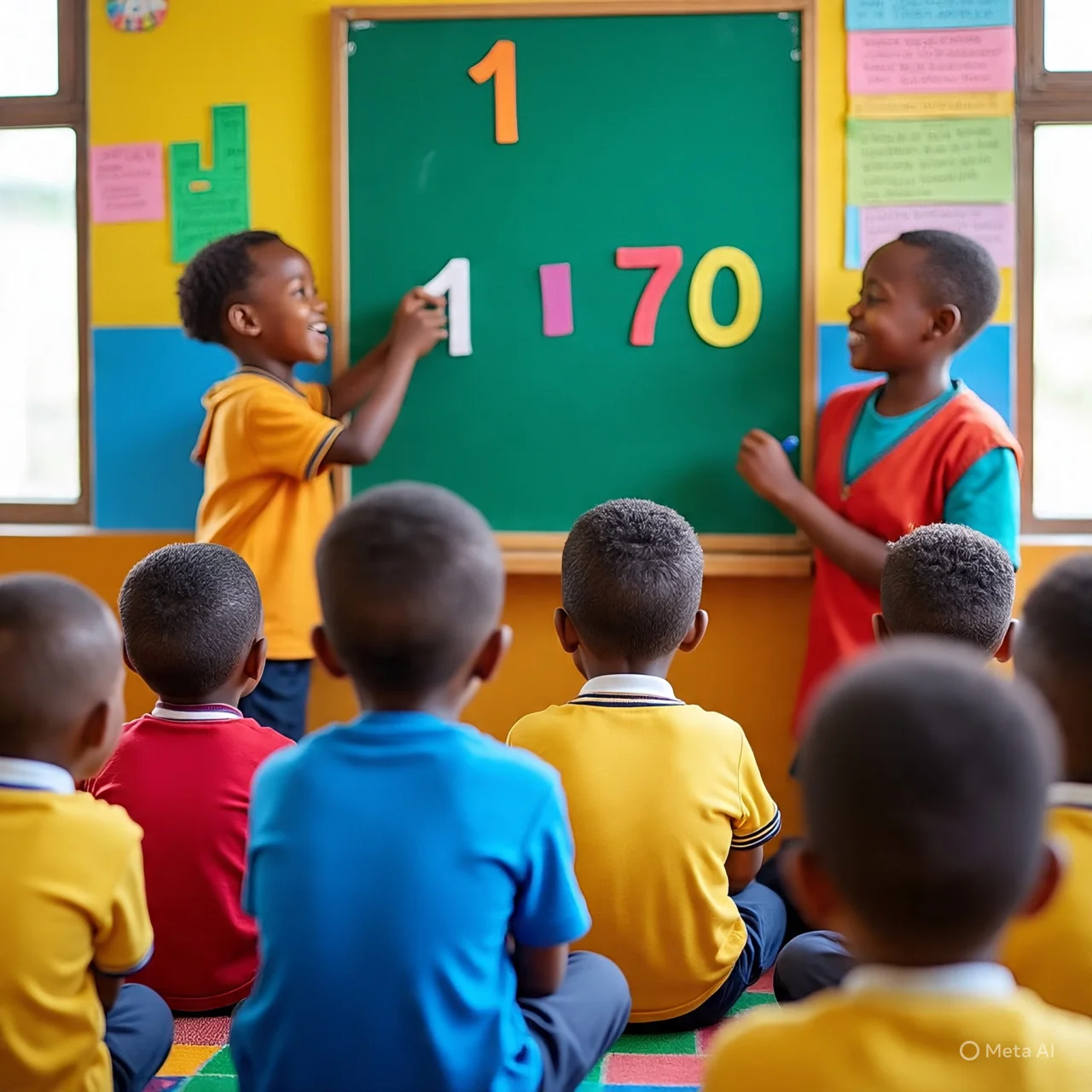
A bright Nigerian classroom with happy pupils revising math with their teacher, colourful number charts and counting sticks on tables, cheerful atmosphere, realistic and child-friendly.

Solving Equations With Fractions for JSS 3 | Lessonshabitat

Posted on 12/12/2025 By LessonsHabitat No Comments on Solving Equations With Fractions for JSS 3 | Lessonshabitat


Table of Contents

Toggle
  • LESSON PLAN
  • SUBJECT: Mathematics
  • CLASS: JSS 3
  • TERM: Second Term
  • WEEK: Week 2
  • AGE: 13–14 Years
  • TOPIC: Solving Equations with Fractions
  • SUB-TOPIC: Simple Fractional Equations and Word Problems
  • DURATION: 40 Minutes
  • BEHAVIOURAL OBJECTIVES
  • KEYWORDS & MEANINGS
  • SET INDUCTION (Story)
  • ENTRY BEHAVIOUR
  • LEARNING RESOURCES & MATERIALS
  • BUILDING BACKGROUND KNOWLEDGE
  • EMBEDDED CORE SKILLS
  • REFERENCE BOOKS
  • INSTRUCTIONAL MATERIALS
  • CONTENT
    • A. Meaning of Fractional Equations
  • 10 EXAMPLES (WordPress-Friendly Format)
  • B. In-Depth Explanation (With WordPress-Friendly Fractions)
      • 1. Clearing Denominators
      • 2. Fractions on Both Sides
      • 3. Word Problems
      • 4. Real-Life Lagos Example
      • 5. Variable in Denominator
  • TEACHER’S ACTIVITIES
  • LEARNERS’ ACTIVITIES
  • CLASS ACTIVITY DISCUSSION (10 FAQs)
  • EVALUATION (Fill-in-the-Blanks with Options)
  • SHORT-ANSWER QUESTIONS
  • CONCLUSION
  • INTERNAL LINKS
  • EXTERNAL LINKS
      • Related posts:

LESSON PLAN


SUBJECT: Mathematics

CLASS: JSS 3

TERM: Second Term

WEEK: Week 2

AGE: 13–14 Years

TOPIC: Solving Equations with Fractions

SUB-TOPIC: Simple Fractional Equations and Word Problems

DURATION: 40 Minutes


BEHAVIOURAL OBJECTIVES

Learners should be able to:

  1. Define fractional equations in simple terms.
  2. Identify equations that contain fractions.
  3. Clear denominators using LCM.
  4. Solve simple fractional equations.
  5. Solve real-life word problems involving fractions.
  6. Explain steps clearly.
  7. Work collaboratively.
  8. Think critically.
  9. Show confidence in solving equations.
  10. Apply knowledge to practical tasks.

KEYWORDS & MEANINGS

  1. Fraction: A part of a whole.
  2. Numerator: The top number in a fraction.
  3. Denominator: The bottom number in a fraction.
  4. Equation: A statement that shows two expressions are equal.
  5. Variable: A letter that stands for an unknown value.
  6. Clear Denominator: Removing denominators by multiplying through with the LCM.
  7. LCM: Least Common Multiple.
  8. Simplify: Make an expression easier.
  9. Operation: A mathematical process like +, –, ×, ÷.
  10. Word Problem: A maths problem written in words.

SET INDUCTION (Story)

“Last weekend at Agege market, I went to buy puff-puff from Mama Tawa. I wanted one full bag, but she said she only had 2/3 of the bag left. A boy beside me said, ‘Aunty, that is a fraction. Solve it!’ The whole crowd laughed.

I asked him, ‘If 2/3 equals 6 cups, how many cups make the full bag?’
The class responds and gets involved.

This leads into today’s topic.


ENTRY BEHAVIOUR

Learners already know:

  • how to work with fractions
  • meaning of variables
  • how to solve basic equations
  • how to find LCM

They are ready for equations with fractions.


LEARNING RESOURCES & MATERIALS

  • Fraction charts
  • Number line
  • Real objects (cups, paper strips)
  • Whiteboard markers
  • Flashcards
  • Lagos State Mathematics textbook

BUILDING BACKGROUND KNOWLEDGE

Teacher recalls:

  • numerator and denominator
  • addition and subtraction of fractions
  • multiplying both sides of an equation by the same number
  • how to find LCM

Learners answer quick revision questions.


EMBEDDED CORE SKILLS

  • Critical thinking
  • Problem-Solving
  • Communication
  • Numeracy
  • Logical reasoning

REFERENCE BOOKS

  • Lagos State Unified Scheme of Work
  • New General Mathematics JSS 3
  • MAN Mathematics Textbook
  • Lessonshabitat.com Notes

INSTRUCTIONAL MATERIALS

  • Flashcards
  • Fraction strips
  • Sample equations
  • Activity sheets

CONTENT


A. Meaning of Fractional Equations

  1. A fractional equation is an equation that contains fractions.
  2. It may have the variable inside the fraction.
  3. We clear denominators using LCM.
  4. After clearing denominators, it becomes a simple equation.
  5. Fractional equations appear in sharing, money, measurement, and real life.

10 EXAMPLES (WordPress-Friendly Format)

  1. x/3 = 5
  2. 2x/5 = 6
  3. (x + 2)/4 = 7
  4. (3x – 1)/2 = 5
  5. x/6 + 2 = 5
  6. (x – 4)/3 = 8
  7. 5x/8 = 10
  8. (x + 1)/2 = 4
  9. (2x – 3)/6 = 9
  10. 4x/3 = 12

B. In-Depth Explanation (With WordPress-Friendly Fractions)


1. Clearing Denominators

Multiply both sides with the LCM.

Example:
x/4 = 3
Multiply both sides by 4:
x = 12


2. Fractions on Both Sides

Example:
(x + 2)/3 = x/6 + 1
LCM = 6
Multiply both sides by 6:
2(x + 2) = x + 6
2x + 4 = x + 6
x = 2


3. Word Problems

Tunde used 2/3 of his rope. If 2/3 = 10m:
(2/3)x = 10
x = 15m


4. Real-Life Lagos Example

Mama Nkechi sells 1/4 bag of garri for ₦800.
Find cost of full bag:
1/4 x = 800
x = 3200


5. Variable in Denominator

Example:
5/x = 2
Cross multiply:
5 = 2x
x = 2.5


TEACHER’S ACTIVITIES

  1. Introduce the topic.
  2. Write sample equations.
  3. Explain clearing denominators.
  4. Solve examples step-by-step.
  5. Ask learners to solve similar questions.
  6. Move around to guide learners.
  7. Correct errors.

LEARNERS’ ACTIVITIES

  1. Listen actively.
  2. Participate in the story.
  3. Attempt examples.
  4. Work in pairs.
  5. Ask questions.

CLASS ACTIVITY DISCUSSION (10 FAQs)

  1. What is a fractional equation?
    An equation with fractions.
  2. Why clear denominators?
    To make the equation simple.
  3. What do we use to clear denominators?
    LCM.
  4. What is a variable?
    A letter for an unknown value.
  5. What is LCM?
    Least Common Multiple.
  6. Why show working?
    To understand each step.
  7. Can fractions appear in real life?
    Yes.
  8. What is the first step?
    Identify denominators.
  9. Is it possible to have fractions on both sides?
    Yes.
  10. What must we do after clearing denominators?
    Solve the remaining equation.

EVALUATION (Fill-in-the-Blanks with Options)

  1. x/2 = 6. x = ___
    a. 10 b. 12 c. 6 d. 4
  2. The bottom part of a fraction is ___.
    a. numerator b. denominator c. sign d. value
  3. LCM of 2 and 4 is ___.
    a. 4 b. 8 c. 6 d. 2
  4. To clear fractions, multiply by ___.
    a. sum b. LCM c. HCF d. base
  5. (x + 3)/3 = 6. x = ___
    a. 12 b. 15 c. 18 d. 9
  6. A letter for an unknown is ___.
    a. variable b. sign c. label d. numerator
  7. 2x/5 = 4. x = ___
    a. 10 b. 6 c. 8 d. 5
  8. A fractional equation contains ___.
    a. shapes b. fractions c. decimals d. angles
  9. LCM of 3 and 6 is ___.
    a. 3 b. 6 c. 9 d. 12
  10. The goal is to make ___ the subject.
    a. x b. numerator c. denominator d. LCM

SHORT-ANSWER QUESTIONS

  1. Define fractional equation.
  2. What is numerator?
  3. What is denominator?
  4. Solve: x/5 = 3
  5. Solve: (x + 2)/4 = 6
  6. Solve: 2x/3 = 10
  7. What is the first step in solving fractional equations?
  8. Solve: 3x/7 = 9
  9. Give one real-life example of a fractional equation.
  10. Why clear denominators?

CONCLUSION

Teacher quickly checks each learner’s work, corrects errors, and praises effort.


INTERNAL LINKS

https://lessonshabitat.com/jss3-mathematics-algebra-basics/
https://lessonshabitat.com/understanding-fractions-for-junior-secondary/
https://lessonshabitat.com/jss-mathematics-lesson-notes-collection/

EXTERNAL LINKS

https://www.khanacademy.org/math/algebra
https://www.ck12.org/math/



Share

Related posts:

  1. Primary 1 Second Term Continuous Assessment Tests
  2. Filling the Gap from 1 to 70 | Primary 1 Second Term Maths Lesson Note
  3. Introduction to Addition of Numbers | Primary 1 Second Term Maths Lesson Note
  4. Addition of Numbers – Primary 1 Second Term Lesson Note
  5. Planting Activities for Primary 5 Pupils: Tools, Spacing, and School Farm
Primary 1 Scheme of Work, Primary 5 Scheme of Work Tags:Mathematics

Post navigation

Previous Post: Hat-Making Lesson Plan for Primary 5 | Meaning, Types & Materials
Next Post: Conjunctions in English Grammar JSS 3 Lesson Note

Related Posts

  • energy-saving lamp, energy saving, bulbs, pear, version, thread, lightbulb, environmentally friendly, lighting, lamp, energy, light, enlightenment, fragile, glowed, 3d, material, structure, rendering, energy saving, energy saving, energy saving, energy saving, energy saving, version, lamp, energy
    Light Energy for Primary 1 – Sources and Importance Primary 1 Scheme of Work
  • blackboard, learn, language, language school, chalk, text, chalkboard, education, school, student, word, communication, english, elementary, course, learning, studying, classroom, gray school, gray education, gray learning, gray study, gray classroom, gray community, gray communication, gray studying, gray language, gray blackboard, language, language, language, language, language
    Types of Nouns for Primary 6 | English Grammar Lesson Notes English Grammar Primary 5
  • Colour
    Living Things Lesson Plan for Primary 1 | Lessonshabitat Primary 1 Scheme of Work
  • Colour
    Phonics M–P Words and Question Practice | Primary 1 English Lesson Primary 1 Scheme of Work
  • Colour Identification & Traffic Light Signs for Primary 1 Basic Science
    Colour Identification & Traffic Light Signs for Primary 1 Basic Science Primary 1 Scheme of Work
  • Skip Counting and Filling Gaps with Subtraction – Primary 1 Lesson
    Skip Counting and Filling Gaps with Subtraction – Primary 1 Lesson Primary 1 Scheme of Work

Leave a Reply Cancel reply

Your email address will not be published. Required fields are marked *

Top Posts

  • Primary 1 Second Term English Studies Lesson Notes | Singular and Plural Objects
  • Living Things Lesson Plan for Primary 1 | Lessonshabitat
  • Weather Lesson for Primary 1 | Second Term Week 10 Basic Science
  • Types of Nouns for Primary 6 | English Grammar Lesson Notes
  • The Hospital: Meaning, People, and Equipment Vocational Aptitude Primary 1

Recent Posts

  • Primary 1 Third Term Examination Questions
  • JSS 3 Basic Technology Third Term Scheme of Work (Lagos State Curriculum)
  • THIRD TERM SCHEME OF WORK for JSS1, JSS2, and JSS3
  • Nursery 1 Civic Education Social Activities
  • Nursery 1 Civic Education Third Term Revision of Good Behaviour

Lessons Habitat

  • About Us
  • Privacy Policy
  • Contact Us
  • Disclaimer
  • Terms and Conditions
  • FAQs

Categories

Search

Search This Site

  • The Hospital: Meaning, People, and Equipment Vocational Aptitude Primary 1
    The Hospital: Meaning, People, and Equipment Vocational Aptitude Primary 1 Primary School Lesson Plans
  • The Silent Killers of School Growth: Recognize and Prevent the Hidden Threats to Your School's Success
    The Silent Killers of School Growth: Recognize and Prevent the Hidden Threats to Your School’s Success Teaching Tips and Guides
  • Security Education Examination for JSS 3 Primary School Lesson Plans
  • Representing Data Using Pie Chart – Mathematics Primary 5 First Term Lesson Note
    Representing Data Using Pie Chart – Mathematics Primary 5 First Term Lesson Note Mathematics
  • Colour
    Primary 1 English Mid-Term Assessment | Week 7 Second Term Primary 1 Scheme of Work
  • Gardening Tools for Kids: Names, Uses, and Fun Stories for Learning
    Gardening Tools for Kids: Names, Uses, and Fun Stories for Learning Primary School Lesson Plans
  • woman, brunette, face, hat, head, portrait, sun hat, young woman, hairstyle, curly hair, sun protection, fashion, model, modeling, woman, woman, woman, brunette, face, face, face, hat, hat, hat, hat, sun hat, sun hat, hairstyle, curly hair, sun protection, sun protection, sun protection, sun protection, sun protection, fashion
    Hat-Making Lesson Plan for Primary 5 | Meaning, Types & Materials Primary 5 Scheme of Work
  • Benefits of Weeds: How Weeds Benefit Humans & Animals
    Benefits of Weeds: How Weeds Benefit Humans & Animals Primary School Lesson Plans

Copyright © 2026 Lessons Habitat.

Powered by PressBook News WordPress theme

This website uses cookies to improve your experience. We'll assume you're ok with this, but you can opt-out if you wish. Read More

Decline Cookie Settings
Accept
Powered by WPLP Compliance Platform
Cookies are small text files that can be used by websites to make a user's experience more efficient. The law states that we can store cookies on your device if they are strictly necessary for the operation of this site. For all other types of cookies we need your permission. This site uses different types of cookies. Some cookies are placed by third party services that appear on our pages.
  • Necessary
    Always Active
    Necessary cookies help make a website usable by enabling basic functions like page navigation and access to secure areas of the website. The website cannot function properly without these cookies.

  • Marketing
    Marketing cookies are used to track visitors across websites. The intention is to display ads that are relevant and engaging for the individual user and thereby more valuable for publishers and third party advertisers.

  • Analytics
    Analytics cookies help website owners to understand how visitors interact with websites by collecting and reporting information anonymously.

  • Preferences
    Preference cookies enable a website to remember information that changes the way the website behaves or looks, like your preferred language or the region that you are in.

  • Unclassified
    Unclassified cookies are cookies that we are in the process of classifying, together with the providers of individual cookies.

Powered by WPLP Compliance Platform
Cookie Settings